
Across South Carolina, the aging population is growing—and so is the urgency to meet its needs with thoughtful, innovative care. With 19.1% of South Carolina’s 5.3 million residents age 65 or older and many living in medically under-resourced rural areas, the state faces a growing shortage of primary care providers trained to meet the complex needs of older adults.
Thanks to a three-year, $370,000 grant from The Duke Endowment, the Medical University of South Carolina (MUSC) College of Nursing is embarking on a groundbreaking initiative that transforms how nurse practitioners (NPs) are educated in geriatric care. This project integrates cutting-edge virtual reality (VR)simulation, expanded didactic training and immersive clinical placements to deliver an inclusive, future-focused approach to primary care for older adults. South Carolina’s Urgent Health Care Need.
By 2030, adults aged 65 and older will make up nearly 20%of the U.S. population, a surge driven by baby boomers and longer life expectancies (US Census). In South Carolina, this reality is compounded by its rural landscape.
These populations frequently face unique challenges: multiple chronic conditions, cognitive decline and the impacts of social determinants of health (SDOH) such as housing, transportation and food insecurity. Yet, the state has only 70board-certified geriatricians and a limited number of adult gerontology nurse practitioners (AGNPs)— comprising just 3.4% of the state’s nurse practitioner workforce (SC Board of Nursing).
Without bold action, this shortfall will widen, threatening the well-being of an under-resourced population. This innovative grant-funded initiative offers a powerful response. Led by Whitney Smith, DNP, APRN, AGPCNP-BC, Interim Assistant Dean of the Graduate Practice Program, the initiative focuses on equipping students with the clinical skills and cultural understanding required to serve South Carolina’s older adults with dignity and excellence. Dr. Smith is joined by assistant directors Mary Leigh Goodman, DNP, APRN, FNP-C, CCRN and Kathleen Lindell, Ph.D., RN, ATSF, FAAN, who bring extensive experience in program design, evaluation and academic leadership. Together, the team is executing a plan that not only strengthens NP education but ensures its long-term sustainability
The Program at a Glance
The College of Nursing’s comprehensive approach weaves together advanced technology and real-world experience to equip NP students with critical tools and perspectives. Over three years, the program introduces:
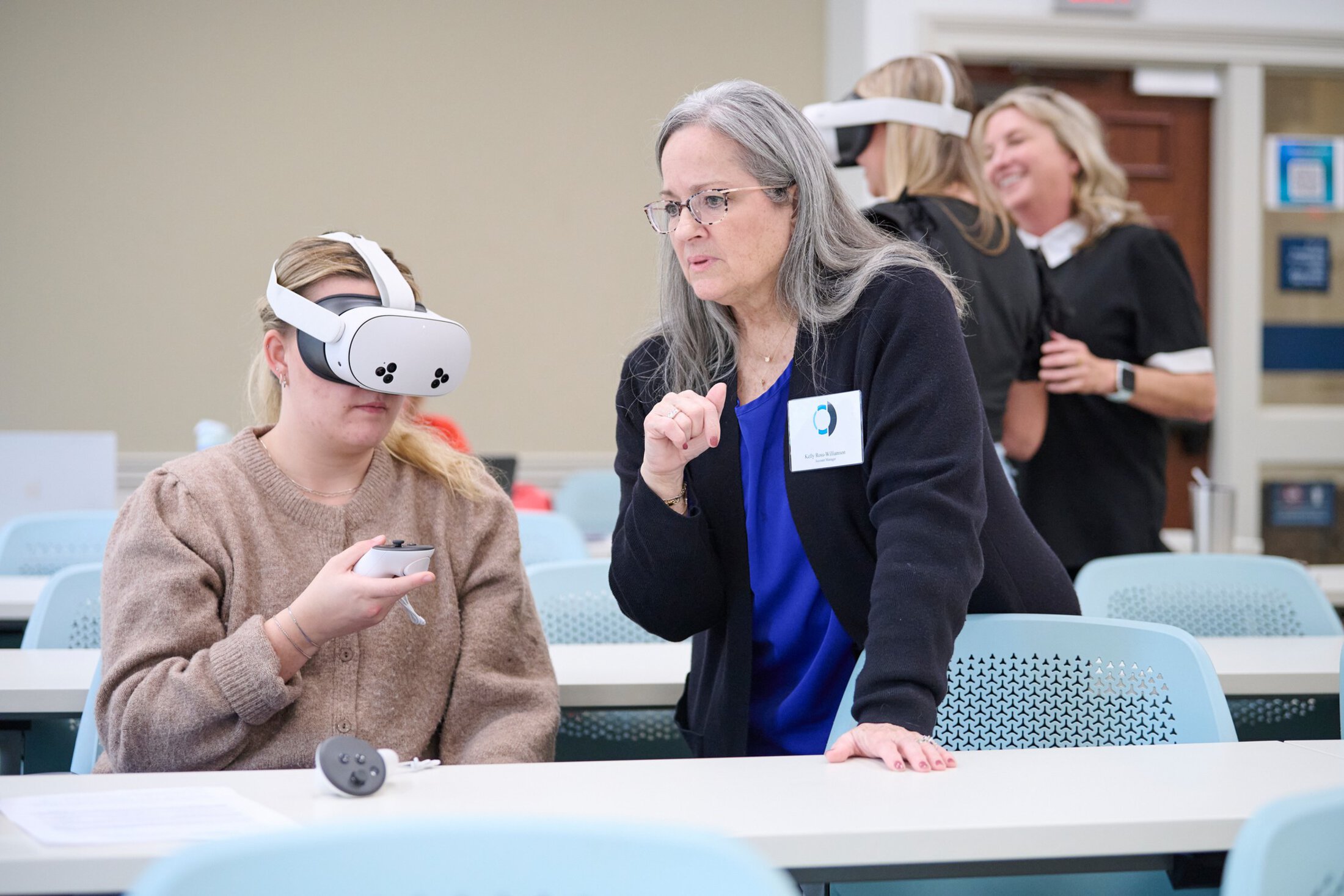
- Two custom-built VR case simulations: Accessible via headsets or personal computers, these cases allow students to practice delivering care in realistic, complex patient encounters involving SDOH, pharmacological challenges and cognitive impairment.
- A robust lecture series: Topics include primary care, memory loss and palliative care, designed to deepen students’ understanding before and after their VR experiences.
- Hands-on clinical rotations: Coordinated through collaborations with the South Carolina Area Health Education Consortium (AHEC), MUSC Hospital, community providers and home-based geriatricians, these placements give students real-world exposure in rural and medically under-resourced communities.
Each year of the program builds strategically. In the first year, a project coordinator will be hired, VR case development will begin and recruitment will target 25 in-state AGNP and Family Nurse Practitioner students.
The second year focuses on implementing the first case, developing the second and integrating lecture content. By the third year, students will complete both simulations and participate in targeted clinical rotations, graduating fully prepared to enter the field. A New Generation of NPs, Ready to Serve. The ripple effects of this project will be long-lasting. Currently, 78% of MUSC’s College of Nursing primary care NP students are South Carolina residents—students who are more likely to return to these areas to practice after graduation.
With new training in geriatrics, cognitive care and the impact of social conditions, graduates will emerge with sharper clinical skills and a deeper commitment to equity and age-friendly care. By the end of the three-year grant period, measurable outcomes will include increased student interest in geriatrics and under-resourced care, improved readiness to address cognitive decline and palliative care needs and enhanced proficiency in evidence-based compassionate care.
Students will earn digital badges signifying their mastery in these competencies, helping future employers identify them as providers of choice for geriatric care. Sustainability and Future Growth. While the grant makes initial development possible, the program is built for longevity.
Faculty will maintain and update all VR content and lectures. The College will also make the VR cases available for purchase by other institutions, generating revenue to reinvest in content updates and new educational tools. The College’s sustainability plan includes:
- Continuing to grow geriatric-focused education for all NP students.
- Strengthening partnerships with AHEC, MUSC’s College of Medicine and Pharmacy and community providers.
- Offering the VR and lecture materials at no cost to students, eliminating financial barriers to participation.
Reaching the Heart of Innovation. This initiative represents more than just a curriculum update. It redefines what it means to care for older adults, meeting them where they are, honoring their lived experiences and training the next generation of NPs to provide care that is both cutting-edge and deeply compassionate.
As the project continues, the College of Nursing is not only addressing a workforce shortage, but it is also reimagining education and setting a new national standard for how technology, collaboration and community engagement can be leveraged to improve health care for older adults.
Recent College of Nursing stories