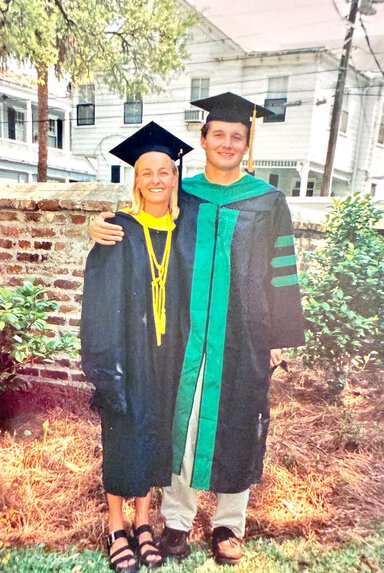


Joshua Moran Jiménez’s relationship, DNP, PMHNP, CARN, CPHQ, NE-BC, with the College of Nursing did not end at graduation. It evolved. As a graduate of both the Accelerated Bachelor of Science in Nursing (ABSN) and Doctor of Nursing Practice (DNP) in Psychiatric Mental Health (PMHNP) programs, he has spent years not just learning within these walls but shaping what happens inside them. From shared governance to quality improvement to clinical research, Dr. Moran Jiménez has remained deeply woven into the fabric of this college and its mission. He shared his story with us, and we think you'll understand why we are so proud to call him one of our own.
What inspired you to pursue nursing and specialize in mental health?
I graduated from the PMHNP program in May 2024. My path to nursing wasn’t linear. I started on a pre-med track, then discovered a passion for psychology while serving as a resident assistant in college.
Supporting first-year students and hearing their struggles sparked a deeper interest in mental health and human connection. After moving to Charleston, I wanted a role where I could make a meaningful impact. With encouragement from my family, I realized psychiatric nursing could combine my psychology background with hands-on care for people in crisis.
That led me to MUSC’s accelerated BSN program and later to inpatient psychiatric work at the Institute of Psychiatry, where I saw opportunities not only to help individuals but to improve systems of care. Pursuing the DNP and PMHNP track felt like the natural next step, allowing me to advocate for patients and advance nursing practice.
What initially attracted you to the College of Nursing, and what aspects of the program stood out most during your experience?
I was drawn to MUSC’s College of Nursing because I wanted a career rooted in relationship-centered care, where I could make a meaningful impact. What stood out most was the program’s intentional integration of evidence-based practice, leadership development, and hands-on learning. Accelerated clinical experiences and interdisciplinary rounds helped me grow quickly, while mentorship from advanced practice nurses broadened my vision for the role.
Continuing into the PMHNP program felt natural. Its clinically aligned curriculum, strong ties to MUSC Health, and emphasis on psychopharmacology, psychotherapy, and integrated care provided the comprehensive training I wanted.
MUSC’s mission to expand mental health access across South Carolina also resonated deeply with my goals. Ultimately, the program’s faculty, clinical opportunities, and commitment to excellence shaped my journey from psychology student to psychiatric nurse and now PMHNP.
The PMHNP program didn’t just prepare me for advanced practice, it positioned me to lead, innovate and influence systems of care in ways I never imagined.
How has your PMHNP track expanded your career opportunities, and did it open any unexpected doors?
Leadership-focused courses inspired me to step into governance and later co-chair the Healthy Work Environment Council, which paved the way for my transition into an assistant nurse manager role. These experiences taught me the power of mentorship, curiosity, and structural empowerment in a Magnet hospital. The PMHNP program didn’t just prepare me for advanced practice, it positioned me to lead, innovate, and influence systems of care in ways I never imagined.
The PMHNP track opened doors I never anticipated. Early coursework like Scientific Underpinnings pushed me to think critically about clinical problems and sparked my interest in evidence-based practice. That led to completing MUSC’s Evidence-Based Practice, Quality and Safety course, advancing on the clinical ladder to RN III, and eventually being considered for a Clinical Practice Nurse Expert role, splitting time between quality improvement and bedside care.
Which skills do you use most in your current role from the program and how did your PMHNP training prepare you for work beyond direct patient care?
One of the most valuable skills I use daily is advanced assessment: synthesizing complex psychosocial, medical, and environmental factors into a clear clinical picture. The PMHNP program strengthened my ability to integrate psychopharmacology knowledge with therapeutic modalities, which is essential in psychiatric emergency settings where decisions often need to be made quickly and holistically.
Beyond direct patient care, the program prepared me for leadership and systems-level thinking. Courses like Frameworks for Leadership and Scientific Underpinnings taught me how to evaluate organizational structures, implement evidence-based interventions, and advocate for policy changes.
These skills have been critical in my roles on shared governance councils and in quality improvement initiatives. The PMHNP training didn’t just teach me how to treat patients, it taught me how to influence systems, mentor colleagues, and implement knowledge from research that advances mental health care.
What inspired your transition into research?
My transition into research was gradual and rooted in curiosity. It began during my ABSN research course, where I first completed CITI training and learned about nursing scholarship. That experience helped me understand the distinctions between Quality Improvement, Evidence-Based Practice (EBP), and Research, and sparked a desire to bridge classroom learning with real-world impact.
Entering the DNP program and working on my RN III project deepened my interest in implementation science and integrating EBP into clinical settings. Joining the New Knowledge and Innovation Council further solidified that passion.
As graduation approached, I realized I wanted a role that combined leadership, research, practice, and education. Today, as a clinical nurse researcher and PMHNP, I mentor nurses in applying EBP and implementation strategies while advancing nursing scholarship. My goal is to foster structural empowerment and collaboration, shifting the perception of nursing from a cost center to a strategic asset that drives innovation and improves patient care.
My goal is to foster structural empowerment and collaboration, shifting the perception of nursing from a cost center to a strategic asset that drives innovation and improves patient care.
What surprised you most about the versatility of the PMHNP career path and the field of mental health nursing?
What surprised me most was how far-reaching the PMHNP role can be. Initially, I imagined working primarily in inpatient or outpatient psychiatry, but I quickly learned that PMHNPs are needed in integrated primary care, telehealth, correctional health, schools, and even policy development. The ability to move between clinical practice, leadership, research, and education is incredible. I didn’t anticipate that this role would open doors to organizational councils, Magnet initiatives, and even opportunities to mentor nurses in evidence-based practice.
Mental health nursing is not confined to one setting. It's a dynamic field that intersects with every aspect of health care. That versatility has allowed me to align my passion for patient care with my interest in structural empowerment and system-level change.
What advice would you give to prospective or current PMHNP students, and what do you wish you had known before starting the program?
Stay connected to your “why.” Reflect on what motivates you and how your work can create meaningful change, not just for patients and families, but for systems that impact access, equity, policy, and the advancement of nursing as a profession.
Also, start thinking early about where you want to publish your DNP project. Select a target journal at the beginning of your program. Publication rates for DNP projects vary, so planning ahead matters. When you submit your manuscript, expect revisions and don’t be discouraged. Even as you transition into practice, seek faculty guidance or resources to help you respond and resubmit effectively.
What continues to motivate you in mental health, and what excites you most about the future of PMHNPs and your long-term goals?
What motivates me most is the human connection; the privilege of sitting with someone in their most vulnerable moments and helping them find hope. Mental health care is deeply relational, and every patient encounter reminds me why this work matters. Looking ahead, I’m excited about the growing emphasis on integrated behavioral health and the use of technology to expand access to care. Telepsychiatry, collaborative care models, and AI-driven tools for early detection are transforming the landscape, and PMHNPs are at the forefront of these innovations.
My long-term goal is to continue bridging clinical practice with research and leadership, advocating for mental health equity, and shaping policies that strengthen nursing’s role as a strategic asset. Ultimately, I want to help create systems where mental health care is accessible, stigma-free, and deeply patient-centered.
Is there anything else you’d like to share about your journey, your experience in the program, or what being a PMHNP means to you?
Being a PMHNP means more than holding a credential, it represents a commitment to advocacy, compassion, and lifelong learning. My journey from psychology to nursing to advanced practice has taught me that mental health care is not just about treating symptoms; it’s about restoring dignity and empowering individuals to reclaim their lives.
The PMHNP program challenged me, inspired me, and ultimately equipped me to lead change, not only for patients but for the profession of nursing.
If I could leave one message for future PMHNPs, it would be this: lean into curiosity, seek mentors, and never underestimate the impact you can have when you combine clinical expertise with vision and purpose. This role is a calling, and it has the power to transform lives, including your own.